What is Art Therapy? And What Makes it so Amazing?
Have you been wondering ‘What is Art Therapy?’ Maybe you know someone who has started seeing an Art Therapist or Art Psychotherapist – or perhaps you’ve been wondering if it might be something that you’d like to try out. You may even be wondering if Art Therapy might be a good profession for you to go into.
In this article I’m going to answer the question ‘What is Art Therapy?’ and I hope to show you how amazing and helpful it can be.
I’ve divided this article into six parts. You’ll find out:
- Part 1: Why people go to Art Therapy
- Part 2: The difference between Art Therapy and Art as Therapy
- Part 3: 12 reasons why using the arts in therapy can be so valuable
- Part 4: What actually happens in an Art Therapy session
- Part 5: Frequently asked questions about Art Therapy
- Part 6: Further reading
Let’s get started.
What is Art Therapy, Part 1:
Why do people go to Art Therapy?
You may choose Art Therapy because you are trying to make sense of something in your life, so that it doesn’t have such a bad effect on you. It might be:
- Issues from the past that are still affecting you, like bullying, abuse or loss
- Feeling worried and overwhelmed
- Feelings like anxiety, shyness, anger or depression
- Difficulties with body image
- A feeling of not knowing who you really are
- Problems with your relationships
- Trying to cope with major life changes
- Knowing you’re too hard on yourself, but not knowing how to change that
- …Or it might be simply a sense that you could get even more out of life if you understood yourself better!
What is Art Therapy, Part 2:
What’s the difference between Art Therapy, and Art as Therapy?
Art Therapy is a form of psychotherapy, and involves the professional relationship between the therapist and the client, along with the therapist’s professional skills and knowledge. Art Therapists (also known as Art Psychotherapists) have to get a Master’s degree in the subject, so it’s a pretty rigorous training. (Note: In the UK, Art Therapist and Art Psychotherapist are legally protected titles; no-one can call themselves that unless they are properly trained and HCPC-registered.)
Art as therapy is basically the idea that art-making can, in itself, be very therapeutic. People of all cultures (and probably throughout history) have used art to help themselves feel better in all sorts of ways. Whether you are an art-maker or an art-appreciator, or both, you will probably understand the calming/ enlivening/ inspiring impact that art can have on you.
If you are using the arts on your own, or with someone who is not a trained and registered Art Therapist, it may be therapeutic in various ways, but it is not Art Therapy.
What is Art Therapy? Share on X
What is Art Therapy, Part 3:
Why use the arts in therapy?
Good question! Here are 12 great reasons for using the arts in therapy.
(And if you have more, let me know in the comments section at the end of this post!)
1. Access to your unconscious mind
It can be a wonderful way of accessing a rich source of unconscious inner wisdom, because you’re tuning into a different part of your brain, a part that gets away from the usual word-based thinking part that you usually use.
2. Clarifying and bringing insight
Your art image can bring a heightened awareness of something that somehow you’ve always ‘known’ but couldn’t quite put your finger on. Putting something on paper can help clarify things – and the insights it brings can feel deeply satisfying.
3. Making things less scary
Once something has come out onto the paper, you and your therapist can talk about it, which can help transform it into something that feels less toxic or scary.
4. When it’s too hard to say it out loud
Sometimes it may feel too shaming or exposing to put your difficult thoughts or experiences into words. Using art images can really help here, so that you can let the therapist know something about what has happened, without you having to say it out loud.
5. Gets you emotionally connected
Sometimes if you talk about something you can feel quite detached from it. And emotional detachment does not lead to much real change. Using images in therapy can help you to get a deeper, more ‘felt’ and emotionally connected quality. This can help you to move on so that you can really allow change to happen.
6. Helps you feel satisfied and more peaceful
It can feel incredibly satisfying when you have been able to find the images to convey the exact feeling of an emotional experience. You may experience a feeling of peace because something has been expressed properly that needed to be expressed.
7. You can try out new ways of being
Through art materials, you can ‘rehearse the possible’ and experiment with finding different possible ways you might live differently and more authentically.
8. You can say more
Communicating through images and metaphor can convey many different meanings, perceptions, and feelings about an experience, all at the same time. It’s much richer and fuller than non-metaphorical language.
9. If you’re very articulate, it can free you up
If you’re always very articulate and good with words, then using the arts in therapy can get you ‘out of your head’. This can be very refreshing, and open doors to new ways of expressing things.
10. If you can’t use words well, you can feel better understood
If you’re someone who doesn’t feel very articulate with words, using the arts in therapy can feel like a huge relief, because you can make yourself understood in a very direct way.
11. You can express things that cannot be put into words
Using images can be a very full and profound form of description: all sorts of qualities, atmospheres and energies can be expressed.
12. You can connect with memories in a fuller way
Things that we remember are often partly held in our senses – smell, touch, sound, texture, colour, etc. Using the arts, we can connect with and release memories in a fuller sensory way.
What is Art Therapy? Share on XWhat is Art Therapy, Part 4:
What happens in Art Therapy sessions?
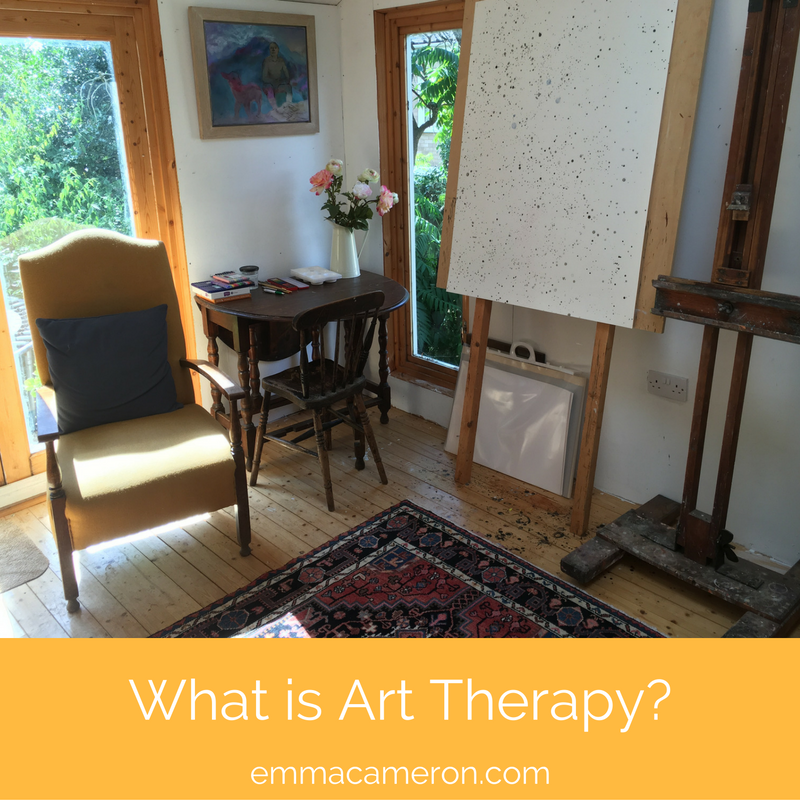
No two Art Therapy sessions are the same, so I can’t tell you exactly what will happen in your Art Therapy session. The most important things that happen in Art Therapy sessions are unique, co-created by you and your Art Therapist. These may include moments of emotional connection and insight that make it genuinely possible for you to move on with your life in new, fresh ways.
But I can describe some of the basic ‘frame’ of Art Therapy — things like the setting, how a session may begin, how much talking and how much art-making there is, what the Art Therapist is doing while you make your art image, what happens when you’ve finished making your image, etc. To read about these things, please read my article ‘What Happens In An Art Therapy Session?’
What is Art Therapy, Part 5:
Frequently asked questions about Art Therapy
If you’ve read through Parts 1-4 above, and still have a question about what happens in Art Therapy, or what is Art Therapy, read my article ‘Art Therapy – Frequently Asked Questions’ and see if you can find the answer there.
What is Art Therapy, Part 6:
Further reading
For more information about Art Therapy, you may like to visit the following websites:
British Association of Art Therapists
Health & Care Professions Council
I hope that this article has helped answer the question, What is Art Therapy?
Is there something you’re still curious about, with regard to what happens in Art Therapy?
Or maybe you’re a fellow Art Therapist and you feel there’s something I’ve missed out in this blog post?
Please write in the comments below – I’d love to hear from you!